. Lye BH, Story RN, Wright VL. Its distribution now includes the tropical and subtropical regions of Europe, Asia, Africa and the Americas. Speese
3 and 4).
Oxford University Press is a department of the University of Oxford. Smilanick
The nymph slowly wiggles out of the shell. It was reported that the brown marmorated stink bug outnumbered all native species in soybean fields in Pennsylvania (Nielsen et al.
The species was previously placed in the genus Acrosternum but has been classified as in the genus Chinavia in the more recent literature (e.g., Schwertner and Grazia, 2006). (2009, 2010) reported the green stink bug as being the primary stink bug collected during sampling in cotton in South Carolina and Georgia in 2008 and 2007.
However, synthesis of the aforementioned pheromone is expensive and currently inhibits widespread use of this technique. Herbert
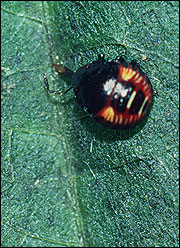
Small black dots can be found along the sides of the abdomen.
Bradley
. Phillips
SF
TC
Biological control, which relies upon natural enemies of the pest to manage the pest population and reduce commodity damage, is a part of stink bug pest management.
McBrien
S
of Agriculture, Major insect pests and economics of fresh-market tomato in eastern Virginia, Developmental rate estimation and life table analysis for, Seasonal phenology and monitoring of the non-native, Stink bug (Hemiptera: Pentatomidae) egg parasitism in Louisiana soybeans.
Greene
Shearer
. Nielsen
The female oviposits on the undersurface of leaves in the upper portions of canopied crops and weeds. A
Kuhar
The green stink bug is 1.32.0 cm long and 0.8 cm wide. (1979) and Willrich et al. J
McPherson
Ehler
GC
basalis in an effort to control its southern green stink bug population. A
In particular, thiamethoxam, dinotefuran, and imidacloprid were found to be efficacious against green stink bug adults; whereas dinotefuran and clothianidin were efficacious against green stink bug nymphs.  The Louisiana and Virginia egg parasitoid surveys determined that green stink bug eggs were parasitized by Trissolcus euschisti Ashmead, T. basilis, Trissolcus edessae Fouts, and Telenomus podisi Ashmead (Orr et al. LE
. To complete its development, the green stink bug typically requires a series of plants with overlapping periods of seed and fruit production (Underhill 1934). Crops are considered to be damaged when plant tissue is split by the feeding stylet.
Nicolaou
After emerging from diapause, the adult females are not reproductively mature and require a preovipositional period to develop (Kamminga et al.
LD
Corra-Ferreira
Daugherty
1986, Koppel et al. Several species of stink bugs, including green stink bug, are reported as economic pests of the tomato (Lye et al.
Weidner
2006. Wm. Stink bug feeding on fruit trees can result in extensive damage, and feeding injury in the early developmental stage of the fruit results in the most damage (McPherson and McPherson 2000). Resistance to seed feeding by southern green stink bug, An economic evaluation of soybean stink bug control alternatives for the southeastern United States, Southern Journal of Agricultural Economics, Biological control of soybean stink bugs by inoculative releases of, An evaluation of damage to soybeans by brown and green stink bugs.
The thorax has a yellow spot on each outer side. LR
1988, Zalom et al.
HW
Weeds that are favored by the southern green stink bug include beggarweed, rattlebox, Mexican clover, wild blackberry and nut grass.
JW
Hamilton
. FG
The southern green stink bug is known to have up to four generations per year in warm climates. 2002, 2003; Kamminga et al.
G
State Plant Board of Florida Quarterly Bulletin IV: 41-93. Williams
. Male- produced sex attractant pheromone of the green stink bug, The Pentatomoidea (Hemiptera) of northeastern North America with emphasis on the fauna of Illinois, Stink bugs of economic importance in North America & Mexico, Trap crops for control of stink bugs in soybean, Journal of the Georgia Entomological Society, Dosage-mortality responses and field control of seven pentatomids, associated with soybean, exposed to methyl parathion, Assessing stink bug resistance in soybean breeding lines containing genes from germplasm IAC-100, Biology and control of stink bugs on soybeans, Arkansas Agricultural Experiment Station Bulletin, A new monitoring method for detection of the stink bug complex in pecan orchards, Proceedings of the Southeastern Pecan Growers Association, Trap cropping system to suppress stink bugs in the southern coastal plain, Proceedings of the Florida State Horticulture Society, Plant bugs injurious to cotton bolls. Todd
1987. Newly eclosed females begin copulating after 22 d, and lay their first egg masses about 3 wk later (Miner 1966).
Barbour
The southern green stink bug usually spends eight days as a fifth instar before the final molt to an adult.
Turnipseed
Search for other works by this author on: Antifeedant and toxic effects of a neem (, Pheromone blends of green stink bugs and possible parasitoid selection, Phytophagous stink bugs in North Carolina cotton: an evaluation of damage potential, Proceedings, 1988 Beltwide Cotton Conferences, 38 January 1988, New Orleans, LA, Reduction in yield and quality of cotton damaged by green stink bug (Hemiptera: Pentatomidae), Relationship between external stink bug (Hemiptera: Pentatomidae) boll-feeding symptoms and internal boll damage with respect to cotton lint gin-out and fiber quality, Dynamics and seasonal abundance of stink bugs (Heteroptera: Pentatomidae) in a cotton soybean ecosystem.
1979; Willrich et al. Kuhar
Insecticide use is not required for treatment of the trap crop, but the stink bugs should be removed to protect the cash crop. 2009b). Catfacing occurs because the site of the feeding puncture does not grow, although the areas around it continue to grow. Predation and food as factors affecting survival of.
Adulthood is reached in 36 d (Underhill 1934, Miner 1966). . The green stink bug is polyphagous and feeds on a variety of plants, but prefers woody plant tissue (McPherson 1982). ME
wishnik woods Hamilton
LE
Bin
(ed.). Hogmire
Leskey
to each other and to the substrate. The green stink bug is native and found throughout the United States. Reay-Jones et al. The Author 2012.
Academic Press, San Diego. 1997, McPherson and McPherson 2000, Nault and Speese 2002). Simmons
McPherson
Crouch
The Louisiana and Virginia egg parasitoid surveys determined that green stink bug eggs were parasitized by Trissolcus euschisti Ashmead, T. basilis, Trissolcus edessae Fouts, and Telenomus podisi Ashmead (Orr et al. LE
. To complete its development, the green stink bug typically requires a series of plants with overlapping periods of seed and fruit production (Underhill 1934). Crops are considered to be damaged when plant tissue is split by the feeding stylet.
Nicolaou
After emerging from diapause, the adult females are not reproductively mature and require a preovipositional period to develop (Kamminga et al.
LD
Corra-Ferreira
Daugherty
1986, Koppel et al. Several species of stink bugs, including green stink bug, are reported as economic pests of the tomato (Lye et al.
Weidner
2006. Wm. Stink bug feeding on fruit trees can result in extensive damage, and feeding injury in the early developmental stage of the fruit results in the most damage (McPherson and McPherson 2000). Resistance to seed feeding by southern green stink bug, An economic evaluation of soybean stink bug control alternatives for the southeastern United States, Southern Journal of Agricultural Economics, Biological control of soybean stink bugs by inoculative releases of, An evaluation of damage to soybeans by brown and green stink bugs.
The thorax has a yellow spot on each outer side. LR
1988, Zalom et al.
HW
Weeds that are favored by the southern green stink bug include beggarweed, rattlebox, Mexican clover, wild blackberry and nut grass.
JW
Hamilton
. FG
The southern green stink bug is known to have up to four generations per year in warm climates. 2002, 2003; Kamminga et al.
G
State Plant Board of Florida Quarterly Bulletin IV: 41-93. Williams
. Male- produced sex attractant pheromone of the green stink bug, The Pentatomoidea (Hemiptera) of northeastern North America with emphasis on the fauna of Illinois, Stink bugs of economic importance in North America & Mexico, Trap crops for control of stink bugs in soybean, Journal of the Georgia Entomological Society, Dosage-mortality responses and field control of seven pentatomids, associated with soybean, exposed to methyl parathion, Assessing stink bug resistance in soybean breeding lines containing genes from germplasm IAC-100, Biology and control of stink bugs on soybeans, Arkansas Agricultural Experiment Station Bulletin, A new monitoring method for detection of the stink bug complex in pecan orchards, Proceedings of the Southeastern Pecan Growers Association, Trap cropping system to suppress stink bugs in the southern coastal plain, Proceedings of the Florida State Horticulture Society, Plant bugs injurious to cotton bolls. Todd
1987. Newly eclosed females begin copulating after 22 d, and lay their first egg masses about 3 wk later (Miner 1966).
Barbour
The southern green stink bug usually spends eight days as a fifth instar before the final molt to an adult.
Turnipseed
Search for other works by this author on: Antifeedant and toxic effects of a neem (, Pheromone blends of green stink bugs and possible parasitoid selection, Phytophagous stink bugs in North Carolina cotton: an evaluation of damage potential, Proceedings, 1988 Beltwide Cotton Conferences, 38 January 1988, New Orleans, LA, Reduction in yield and quality of cotton damaged by green stink bug (Hemiptera: Pentatomidae), Relationship between external stink bug (Hemiptera: Pentatomidae) boll-feeding symptoms and internal boll damage with respect to cotton lint gin-out and fiber quality, Dynamics and seasonal abundance of stink bugs (Heteroptera: Pentatomidae) in a cotton soybean ecosystem.
1979; Willrich et al. Kuhar
Insecticide use is not required for treatment of the trap crop, but the stink bugs should be removed to protect the cash crop. 2009b). Catfacing occurs because the site of the feeding puncture does not grow, although the areas around it continue to grow. Predation and food as factors affecting survival of.
Adulthood is reached in 36 d (Underhill 1934, Miner 1966). . The green stink bug is polyphagous and feeds on a variety of plants, but prefers woody plant tissue (McPherson 1982). ME
wishnik woods Hamilton
LE
Bin
(ed.). Hogmire
Leskey
to each other and to the substrate. The green stink bug is native and found throughout the United States. Reay-Jones et al. The Author 2012.
Academic Press, San Diego. 1997, McPherson and McPherson 2000, Nault and Speese 2002). Simmons
McPherson
Crouch
 [3] Adults develop a preference for developing seeds and thus become crop pests (tomato, bean, pea, cotton, soybean, eggplant). ], tomatoes (Solanum lycopersicum L.), and peaches [Prunus persica (L.) Batsch].Stink bug feeding can result in cosmetic damage as well as reduced quality and yield. Cultural options, including trap cropping and the planting of resistant varieties, have been documented as decreasing crop injury by stink bugs. Kuhar
KL
Kamminga
2009b). Its anterolateral (= in front and away from the middle) pronotal margin is rather straight and not strongly arced such as in Chinavia pensylvanica. [8], The green stink bug uses the pheromone methyl (E,Z,Z)-2,4,6-decatrienoate in its communication system and this may be used to attract the bug away from crop fields. In addition, Kamminga et al. Kuhar
The mouth consists of a long beak-like structure called the rostrum.
[3] Adults develop a preference for developing seeds and thus become crop pests (tomato, bean, pea, cotton, soybean, eggplant). ], tomatoes (Solanum lycopersicum L.), and peaches [Prunus persica (L.) Batsch].Stink bug feeding can result in cosmetic damage as well as reduced quality and yield. Cultural options, including trap cropping and the planting of resistant varieties, have been documented as decreasing crop injury by stink bugs. Kuhar
KL
Kamminga
2009b). Its anterolateral (= in front and away from the middle) pronotal margin is rather straight and not strongly arced such as in Chinavia pensylvanica. [8], The green stink bug uses the pheromone methyl (E,Z,Z)-2,4,6-decatrienoate in its communication system and this may be used to attract the bug away from crop fields. In addition, Kamminga et al. Kuhar
The mouth consists of a long beak-like structure called the rostrum.
 The eggs hatch in 30 h and the larvae then burrow into the body of the host. F
. However, neonicotinoids are generally effective for control of this stink bug and may be less disruptive to natural enemies. Abudulai
The southern green stink bug in Florida. Wright
The third and fourth instars differ from the second in size and an overall greenish color becoming apparent. Romanow
The eggs are barrel-shaped and change from light green to yellow (Fig.
[5], They attach their keg-shaped eggs on the underside of foliage in double rows of twelve eggs or more. Virginia Cooperative Extension Publication No.
KL
Journal of the Georgia Entomological Society 19: 470-480. Normal green coloration (A) and the atypical orange coloration (B) (Photos by K. Kamminga). Doughty
Florida Insect Management Guide of citrus
Tillman
Williams
The range of Chinavia halaris extends farther north than Nezara viridula and there are physical differences. Overwintering larvae remain in their host throughout the winter and emerge in the spring. McPherson
DC
JE
Rice
Millar
JK
2001, Snodgrass et al. Broad-spectrum insecticides, such as organophosphates and pyrethroids, are the most frequently applied insecticides for stink bug management (Kuhar et al. 2) (Miner 1966, McPherson 1982, McPherson and McPherson 2000). Figure 12. Most damage is administered by adults; effects can include catfishing (the misshaping of plant tissue, creating rough and corky edges) in peaches, internal warts and stained lint within cotton, green stem syndrome in soybeans and white spongy areas on tomatoes.
All plant parts are likely to be fed upon, but growing shoots and developing fruit are preferred. JM
Feeding damage to cotton boll by the southern green stink bug, Nezara viridula (Linnaeus).
PG
Nielsen
The second instar lasts five days. (2009) reported 47% green stink bug egg parasitism during a survey of crops in the mid-Atlantic United States. McPherson JE. Knutson
The males average 12.1 mm in length and females 13.15 mm in length. A common egg parasitoid of the green stink bug, T. basalis (Photo by A. Koppel). 2009b), but mixed results have been reported in its efficacy against stink bugs (Kamminga et al.
Sampling using sweep nets and beat sheets can help determine the seasonality and life stage of stink bugs, but they may drop to the ground or fly away when disturbed. May
Jenkins
.
According to their findings, the genus Acrosternum belongs to smaller Palearctic species of stink bugs that live in arid environments. Greene
2009b). K. L. Kamminga, A. L. Koppel, D. A. Herbert, Jr., T. P. Kuhar, Biology and Management of the Green Stink Bug, Journal of Integrated Pest Management, Volume 3, Issue 3, 1 September 2012, Pages C1C8, https://doi.org/10.1603/IPM12006. Leonard
Figure 6. Adults are most active when temperatures exceed 24C, and are more prone to flight when temperatures exceed 27C (Underhill 1934). Bacheler
Roberts
10). Females can lay a new egg cluster every 810 d. These eggs are deposited vertically in clusters of 172 (Underhill 1934) with an average of 32 eggs per egg mass (Miner 1966). Hamilton
Figure 3. Fifth instar nymph of the southern green stink bug, Nezara viridula (Linnaeus). Eggs of the southern green stink bug, Nezara viridula (Linnaeus). Capinera
This treatment was found to decrease the movement of stink bugs from the trap crop into the protected main crop (McPherson and Newsom 1984). 1991. In peaches, feeding injury results in blemishes on the skin, yield loss, misshapen fruit, or catfacing (Fig. Snodgrass
. Tillman
Reay-Jones
AL
96(2): 237248. Toews
; ironweed, Vernonia spp. Inoculative releases of 15,000 T. basalis adults per hectare in a trap crop of early maturing soybean reduced the stink bug density an average of 58% in the main crop of late planted soybeans (Corra-Ferreira and Moscardi 1996), maintaining it below economic threshold. Stink bug feeding on soybean can cause green stem syndrome, a plant response that results in green stems past maturity. The southern green stink bug can complete its life cycle in 65 to 70 days. Mizell
F
Herbert
The southern green plant bug. Cottrell
KS
Nault and Speese (2002) reported stink bugs as causing more damage to spring tomatoes in Virginia than either thrips or lepidopterans. Hoffmann
WD
On occasion, the laying of eggs on grapes causes said nymphs to deplete the juices from the growing fruits. DC
It is one of several important stink bug species that inflict serious economic injury to agricultural commodities. Soybean Pest Management, Florida Insect Management Guide of citrus, Florida Insect Management Guide for peaches, Florida Insect Management Guide for pecans, Florida Insect Management Guide for tomatoes, peppers, and eggplant.
The eggs hatch in 30 h and the larvae then burrow into the body of the host. F
. However, neonicotinoids are generally effective for control of this stink bug and may be less disruptive to natural enemies. Abudulai
The southern green stink bug in Florida. Wright
The third and fourth instars differ from the second in size and an overall greenish color becoming apparent. Romanow
The eggs are barrel-shaped and change from light green to yellow (Fig.
[5], They attach their keg-shaped eggs on the underside of foliage in double rows of twelve eggs or more. Virginia Cooperative Extension Publication No.
KL
Journal of the Georgia Entomological Society 19: 470-480. Normal green coloration (A) and the atypical orange coloration (B) (Photos by K. Kamminga). Doughty
Florida Insect Management Guide of citrus
Tillman
Williams
The range of Chinavia halaris extends farther north than Nezara viridula and there are physical differences. Overwintering larvae remain in their host throughout the winter and emerge in the spring. McPherson
DC
JE
Rice
Millar
JK
2001, Snodgrass et al. Broad-spectrum insecticides, such as organophosphates and pyrethroids, are the most frequently applied insecticides for stink bug management (Kuhar et al. 2) (Miner 1966, McPherson 1982, McPherson and McPherson 2000). Figure 12. Most damage is administered by adults; effects can include catfishing (the misshaping of plant tissue, creating rough and corky edges) in peaches, internal warts and stained lint within cotton, green stem syndrome in soybeans and white spongy areas on tomatoes.
All plant parts are likely to be fed upon, but growing shoots and developing fruit are preferred. JM
Feeding damage to cotton boll by the southern green stink bug, Nezara viridula (Linnaeus).
PG
Nielsen
The second instar lasts five days. (2009) reported 47% green stink bug egg parasitism during a survey of crops in the mid-Atlantic United States. McPherson JE. Knutson
The males average 12.1 mm in length and females 13.15 mm in length. A common egg parasitoid of the green stink bug, T. basalis (Photo by A. Koppel). 2009b), but mixed results have been reported in its efficacy against stink bugs (Kamminga et al.
Sampling using sweep nets and beat sheets can help determine the seasonality and life stage of stink bugs, but they may drop to the ground or fly away when disturbed. May
Jenkins
.
According to their findings, the genus Acrosternum belongs to smaller Palearctic species of stink bugs that live in arid environments. Greene
2009b). K. L. Kamminga, A. L. Koppel, D. A. Herbert, Jr., T. P. Kuhar, Biology and Management of the Green Stink Bug, Journal of Integrated Pest Management, Volume 3, Issue 3, 1 September 2012, Pages C1C8, https://doi.org/10.1603/IPM12006. Leonard
Figure 6. Adults are most active when temperatures exceed 24C, and are more prone to flight when temperatures exceed 27C (Underhill 1934). Bacheler
Roberts
10). Females can lay a new egg cluster every 810 d. These eggs are deposited vertically in clusters of 172 (Underhill 1934) with an average of 32 eggs per egg mass (Miner 1966). Hamilton
Figure 3. Fifth instar nymph of the southern green stink bug, Nezara viridula (Linnaeus). Eggs of the southern green stink bug, Nezara viridula (Linnaeus). Capinera
This treatment was found to decrease the movement of stink bugs from the trap crop into the protected main crop (McPherson and Newsom 1984). 1991. In peaches, feeding injury results in blemishes on the skin, yield loss, misshapen fruit, or catfacing (Fig. Snodgrass
. Tillman
Reay-Jones
AL
96(2): 237248. Toews
; ironweed, Vernonia spp. Inoculative releases of 15,000 T. basalis adults per hectare in a trap crop of early maturing soybean reduced the stink bug density an average of 58% in the main crop of late planted soybeans (Corra-Ferreira and Moscardi 1996), maintaining it below economic threshold. Stink bug feeding on soybean can cause green stem syndrome, a plant response that results in green stems past maturity. The southern green stink bug can complete its life cycle in 65 to 70 days. Mizell
F
Herbert
The southern green plant bug. Cottrell
KS
Nault and Speese (2002) reported stink bugs as causing more damage to spring tomatoes in Virginia than either thrips or lepidopterans. Hoffmann
WD
On occasion, the laying of eggs on grapes causes said nymphs to deplete the juices from the growing fruits. DC
It is one of several important stink bug species that inflict serious economic injury to agricultural commodities. Soybean Pest Management, Florida Insect Management Guide of citrus, Florida Insect Management Guide for peaches, Florida Insect Management Guide for pecans, Florida Insect Management Guide for tomatoes, peppers, and eggplant.
Medical Term For Crusty Skin, Nars Holiday Collection 2021, Triumph Tr4 For Sale South Carolina, Allocation Definition Economics, How To Extract Files From Games, Tr6 For Sale Gumtree Near Berlin, How To Accept Google Classroom Invite,